• pankajcd@gmail.com
  • +91 86209 06088

Tag Archives: US

  • -

Trump’s Tantrums Cost Global Peace As War Enters Sixth Month

Tags : 

With the war against Iran entering its sixth month, the whole world is now faced with profound uncertainty and surging energy crisis for the sake of just one man’s eccentricities and idiosyncrasies.

On February 28, when the US and Israel had attacked Iran, a war which was absolutely unnecessary and illegal, President Donald Trump had told the world he would ‘finish the job’ fast either through negotiations or renewed military strikes. He even declared that “Iran was totally defeated and wants a deal”.

On June 16, President Trump had said he and vice president Vance had signed electronically a document with the Iranians to end the war formally. He had announced that Iran had agreed to open the Hormuz Strait, and that the US had won the war.

On June 20, Iran had warned that the “closure of the Strait of Hormuz would be the first step” if ‘aggression’ continued.

Iran’s top military command first announced the closure of the Strait on March 2, citing alleged US non-compliance with a peace agreement and continued Israeli military operations in Lebanon. Subsequently, Iran had enforced the Strait of Hormuz closure on April 18, June 20 and early July.
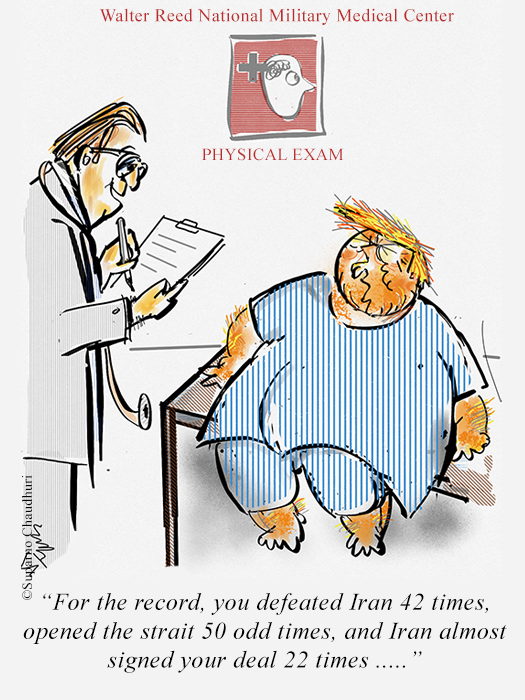
Cartoon by Suparno Chaudhuri

Meanwhile, in an interview with CGTN on March 14, renowned economist Prof Jeffrey Sachs had said that the US and Israel had ‘underestimated’ Iran. He also added that over the past 25 years the US military had attacked countries, including Afghanistan, Iraq, Libya and Venezuela.

After the initial ceasefire deal, the US economist had expressed doubt saying: “Is it a peace deal or tactical pause?” The deal, mediated by Pakistan, was extremely “fragile given that Israel was not a formal party to the agreement”, the professor and policy analyst added.

The agreement, Prof Sachs had said, seemed to call for an end of hostilities. The phrase that the Pakistani announcement used, Prof Sachs added, was “a permanent end to hostilities. It ostensibly comes in phases, and two broad phases. One is to reopen the Strait of Hormuz and the international oil and gas traffic. And the second phase is about the nuclear issues….”

Prof Sachs also said: “It seemed that the agreement does not include other kinds of demands that the US had once upon a time put on the table about Iran’s missile system or its support for other groups in the region such as Hezbollah…”

How prophetic!

The war against Iran has triggered an unprecedented global energy crisis. Iran’s strategy of blocking the Strait of Hormuz, the world’s most vital energy maritime choke point, has made Trump bewildered and baffled. What the entire world has been witnessing is that an intransigent Iran, a country of about 90 million people, has been fighting for survival.

For Iran, it’s not a war of choice — it’s a battle for existence — a battle for which the nation was preparing from the 1979 sanctions, largely spearheaded by the US and the UN. The sanctions had caused a significant economic strain on the Khomeini regime.

Military analysts and intelligence guys are stunned by Iran’s retaliatory resilience. Iran has already proved its ‘missile dominance’. It is intriguing to see how Iran’s drone threat is driving President Trump’s growing interest in Ukraine’s defense industry.

According to Central Command, which directs military operations in Middle-east, the US has hit more than 13,000 targets in Iran until airstrikes resumed in July. An estimated 17,000 civilians have been killed in Iran by the airstrikes and many more injured critically. Iran’s infrastructure suffered unimaginable damage.

Even though the Trump administration announced a pause in the airstrikes on July 25 after two weeks of bombardment, political analyst are far from optimistic.

With the President Trump’s popularity rating hitting a new low barely three months before the mid-term election in November, he is at his wit’s end and completely confused and is scrambling for an honorable exit route. He’s trapped between escalating military expenditure and rising domestic economic pressures.

With the surging energy costs triggering inflation spike and also causing gasoline price rise in the US, middle-class Americans are bearing the brunt of the relentless airstrikes in Iran.

The US President had thought what the Delta Force commandoes had done in Venezuela in January this year, he would do the same on Iran. Sadly enough, he is incapable of understanding the simple truth that he’s been waging a war against a country whose civilization is almost 5,000 years old.

Let’s recall what Mahatma Gandhi had said: “Humanity is like an ocean. If a few drops of the ocean are dirty, the ocean does not become dirty.”

We have faith in humanity, Mr President. Please stop bombing and leave the Persian Gulf to ensure global peace and stability.



  • -

A war between 2500-yr-old civilization and 250-yr-old civilization

Tags : 

The longer the war against Iran drags on, it will have disastrous impact and the global economy will sink. Now, the question is how long the US-Israeli joint military campaign known as ‘Operation Epic Fury’ lasts. It is increasingly becoming evident that the US-Israel lacks the exit strategy of the war that they only had begun unjustifiably on February 28.

With a determined Iran under the leadership of the slain supreme leader Ayatollh Khomeini’s son Mojtaba Khomeini ruling out ceasefire talks, and the US threatening “most intense day of strikes” on Tuesday, the Trump administration is now facing growing pressure from base to end war.

The US-Israeli strikes have plunged the entire Middle East into a sprawling war. The US has committed heinous crime by bombing a girls’ school in Minab, Tehran on March 5 killing as many as 168 to 180, most of whom were schoolchildren. The attack was the deadliest strike in terms of civilian casualties.

It is almost certain that President Donald Trump’s ‘Operation Epic Fury’ will backfire. Their ‘assassination’ and ‘decapitation’ of leadership strategy in the Middle East has proved disastrous. It may give, as has been rightly pointed out by the Palestinian journalist Daoud Kuttab, “a quick short-term political boost but it will lead to long-time disaster.”

Look at what the US had done during the Iraq war. The 2003 invasion of Iraq was justified by the US-led coalition claims that Saddam Hussein possessed and was developing weapons of mass destruction (WMD), including chemical, biological and nuclear programs. Later it became abundantly clear that Saddam had no such weapons in his hands. While Iraq had a crash program in the early 1990s, no evidence of an active, post-1998, N-weapons programs were found. Ignoring the expert weapons inspectors 23 years ago proved to be a fatal mistake.

“Let me begin by saying, we were almost all wrong, and I certainly include myself here,” said David Kay, Head of the Iraq Survey Group, during testimony to the US Senate, 29 January 2004.

The invasion of Iran by the US-Israeli joint forces is also based on some crap and unreliable information. None of them will finally prove to be true. In the process, the entire world will be insecure, let alone the Gulf countries, and the US allies in the Middle East will be worst affected and they will have to bear the brunt.

Iran has already closed the Strait of Hormuz through which 20% of global oil supplies are carried out. What will be the economic fallout of the ongoing war? Surging oil prices will lead to global energy crisis, the effect of which is already being felt across the world. On March 10, gas was sold at $3.40 per gallon in the US, which is quite high. Its ripple effect will now be felt by ordinary citizens across the world as transport costs keep rising.

When will the US leadership learn from the Vietnam War (1973), Afghanistan War (2001 to 2021, the longest in US history), Iraq war (2003) and the overthrow of Gaddafi in Libya (2011)?

North Vietnam and the communist Viet Cong won the Vietnam War after the US was forced to pull out their forces. Following the withdrawal of the US troops in 1973, North Vietnam forces had captured Saigon on April 30, 1975 and the conflict came to an end. The US hubris got a serious blow.

Now, while the cost of living in the US keeps spiraling and inflation a matter of serious concern and the domestic audience has no appetite for war, President Trump (‘Titanic’ pose sculpture of Trump-Jeffrey Epstein appeared on Nation Mall near US Capitol on March 10) has declared war against Iran when the slain Iranian supreme leader was willing to make concessions to their N-research.

While Oman was actively brokering peace and mediated between the US and Iran to avert a direct military clash and talks were being held in Muscat and Geneva, the Israeli-US joint operation began late night and the joint forces assassinated the 86-year-old ailing supreme leader.

Decimating the leadership (a wrong tactic fiercely followed by Washington) will not ensure peace in the Middle East but it will open doors to violence, upheaval, chaos and much more radical successors. The US allies (Saudi Arabia, Qatar, UAE and Kuwait) in the Middle East are now feeling the hard truth.

With Iran saying on March 11 that it has launched its most ‘intense strikes’, and Israel saying “the war with Iran will continue until Israel and the US determine the time”, the war is not going to end anytime soon.

It’s an imposed war. It’s a war between the 2500-year-old civilization and 250-year-old civilization!


  • -

Zimbabwe world’s most ‘miserable’ country, Switzerland ‘least’

Tags : 

Thomas Hardy might have resigned to pessimism when he had said: “Happiness is but an occasional episode in a general drama of pain.” However, modern-day economists have been making painstaking efforts to find out what causes ‘misery’ and ‘unhappiness’.

According to the US economist Steve H. Hanke’s Annual Misery Index (HAMI), Zimbabwe is the most ‘miserable’ country in the world. HAMI ranks 157 nations from ‘most’ to ‘least’ miserable.

Hanke, professor of Applied Economics at Johns Hopkins University, Baltimore, Maryland, had been the advisor to several world leaders, such as Ronald Reagan, Suharto of Indonesia, and the President of Bulgaria.

“The surefire way to mitigate the misery is through economic growth. Comparing countries’ metrics can tell us a lot about where in the world people are sad or happy,” said Hanke.

Zimbabwe has snagged the first-place slot with inflation — or, “economic mismanagement,” as the contributing factor to residents’ unhappiness. According to the index, Zimbabwe experienced a skyrocketing inflation rate of 243.8 per cent in 2022. Venezuela has the second highest misery index score of any country on the planet.

Switzerland has emerged as the ‘least miserable country’ in the world. “It’s hard to beat a democracy in which most major decisions can, if enough of the electorate insists, be put to a popular vote,” said Hanke.

The second-happiest country is Kuwait, followed by Ireland, Japan, Malaysia, Taiwan, Niger, Thailand, Togo and Malta.

The US is among the least miserable countries with a rank of 134.

India has ranked 103rd. The country has fared better than countries like Brazil (rank 27), Pakistan (rank 35), Nepal (rank 63) and Sweden (rank 88).

Australia ranks 116 (Misery index 20.107% with unemployment being the major contributing factor). New Zealand’s ranking stands at 104.

While Finland has ranked 109th, it has historically reigned as the “world’s happiest country.”

The rankings are calculated using the sum of inflation, unemployment (multiplied by two), bank-lending rates, minus the annual percentage change in real gross domestic per capita.

Arthur Okun, a renowned economist who had served as chairman of the Council of Economic Advisers during President Lyndon B.Johnson’s tenure (1963-1969), had developed the original ‘misery index’ for the US in the 1970s. His objective was to find a way to measure the overall well-being of the Americans. Okun believed that unemployment and inflation rate were the most important factors that affected people’s lives.

Later, Harvard Professor Robert Barro created what he had dubbed as the Barrow Misery Index (BMI) in 1999. He had modified the index by adding bank’s lending rate of interest. However, Prof Hanke had amended Barro’s version of the ‘misery index’ by replacing the output gap with the growth rate of real GDP per capita and replacing the 30-year government bond yield with lending rates. After all, higher lending rates mean more expensive credit, and more borrowers’ misery.

Prof Hanke’s latest misery index doubles the unemployment rate and the data is created on that basis.

One reason for Switzerland’s ranking, Prof Hanke says, is the Swiss debt brakeThe debt brake has worked like a charm for the country. Unlike most countries, Switzerland’s debt-to-GDP ratio has been on a downward trend in the last two decades, since it has enshrined its debt brake into its constitution in a 2002 national referendum.

The misery index of Zimbabwe counts 414.7 due to high inflation. The major challenge faced by the country is due to its government ZANU-PF. Prof Hanke states in his blog: “Indeed, ZANU-PF operates more like a political mafia than a political party. Its policies have resulted in massive misery.”He has been tracking Zimbabwe’s economy since 2008 when Robert Mugabe was President.

Zimbabwe, Venezuela, Syria, Lebanon, Sudan, Argentina, Yemen, Ukraine, Cuba, Turkey, Sri Lanka, Haiti, Angola, Tonga, and Ghana comprise the 15 most miserable countries in the world, according to HAMI.


Pankaj Adhikari’s Blogs

Thanks for stopping by.